Artist-in-Residence Program
Established in 2014, the Diefenbunker’s Artist-in-Residence Program fosters connections between the museum, local artists, and the wider Ottawa community through the creation and presentation of art inspired by the history of our national historic site.

The Last Session | Scénario catastrophe
2026 Artist-in-Residence Exhibition
Jean-Sébastien Côté and Julien Morissette
November 13, 2026 to February 7, 2027
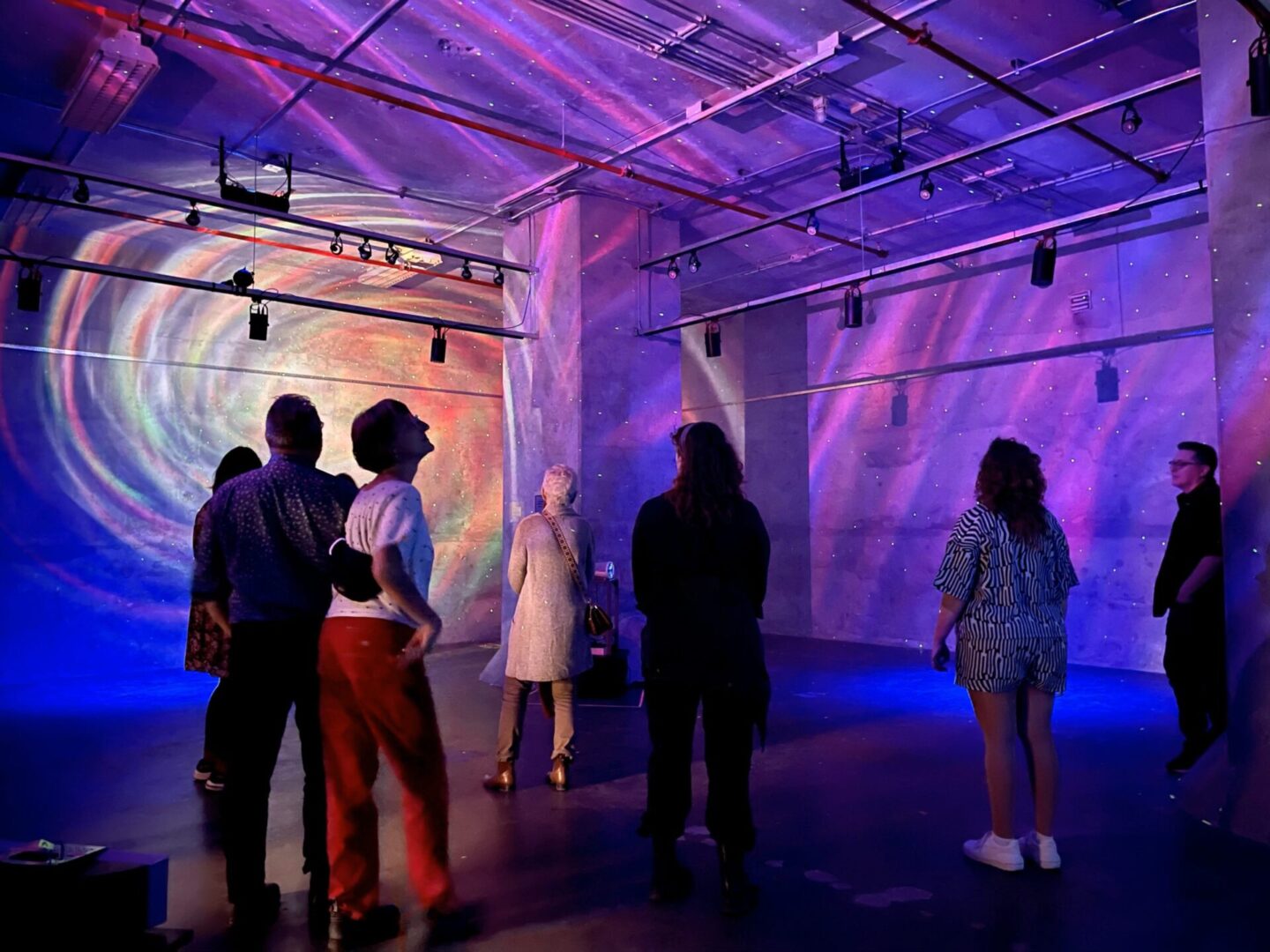
Experience this immersive installation in the Diefenbunker's historic CBC Radio Broadcasting Studio.
Admission to the exhibition is included with museum admission.
Announcing selection for our 2026 Artist-in-Residence Program
We're pleased to announce this year's selection for our Artist-in-Residence Program: introducing Jean-Sébastien Côté and Julien Morissette. Based in Gatineau, Quebec, Côté and Morissette are an artistic duo whose practice explores sound, archives, and physical space. This year, the duo will create an immersive audio installation inspired by the Diefenbunker’s historic CBC Radio Broadcasting Studio. Drawing on archival material and field recordings, their work will explore emergency broadcasts, which blend official messages with the unheard human element behind the voice of authority that the listening public would hear.
The exhibition will open to visitors in November.
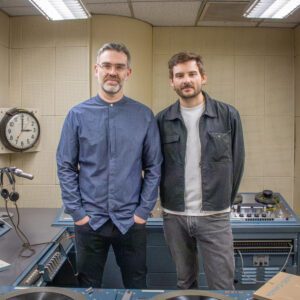
“We don’t just play sound in a space; we use archives and field recordings to make places ‘speak’ in their own register. To us, architecture is an instrument: a door, the hum from an air vent, or a piece of institutional signage is as much a compositional element as a musical note.”
- Jean-Sébastien Côté and Julien Morissette
Past Artists-in-Residence
Olivia Johnston and Neeko Paluzzi, 2025

FLOWER POWER
Olivia Johnston and Neeko Paluzzi
2025 Artists-in-Residence
November 7, 2025 to February 1, 2026
Humanity has an enduring — and often fragile — yearning for peace amid conflict. In Flower Power, follow the familiar motif of the flower, a powerful Cold War symbol for peace, which is woven through two immersive installations. This compelling visual and symbolic thread invites us to contemplate the uneasy dance between beauty and destruction that has shaped our world over the past century.
Spanning the Allard Gallery and the Bank of Canada Vault, this multi-part exhibition draws inspiration from Cold War literature, media, and cultural responses to conflict, employing multiple mediums to explore aspirations and realities of peace.
Olivia Johnston and Neeko Paluzzi are artists based in the Ottawa-Gatineau region and together they form the no collective.
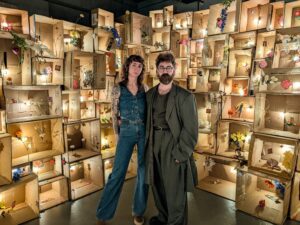
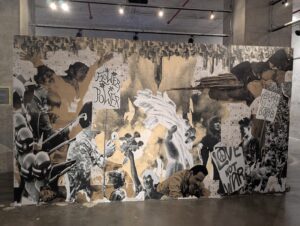
“I learned about the many nuclear disarmament protest movements and integrated some of their imagery into a site-specific installation. Every element of the work was printed, cut, and pasted on site, with visitors witnessing the process unfold. This project could not have been made in a studio — it had to be created in direct response to the bunker’s secluded atmosphere.” Neeko Paluzzi
"Ultimately, I hope Secret Garden encourages viewers to consider what peace looks like in the face of late-stage capitalism and twenty-first-century isolationist tendencies." Olivia Johnston
Don Kwan, 2024
Hidden Heroes
Don Kwan, 2024 Artist-in-Residence
November 8, 2024 to February 2, 2025 *EXTENDED to February 9, 2025
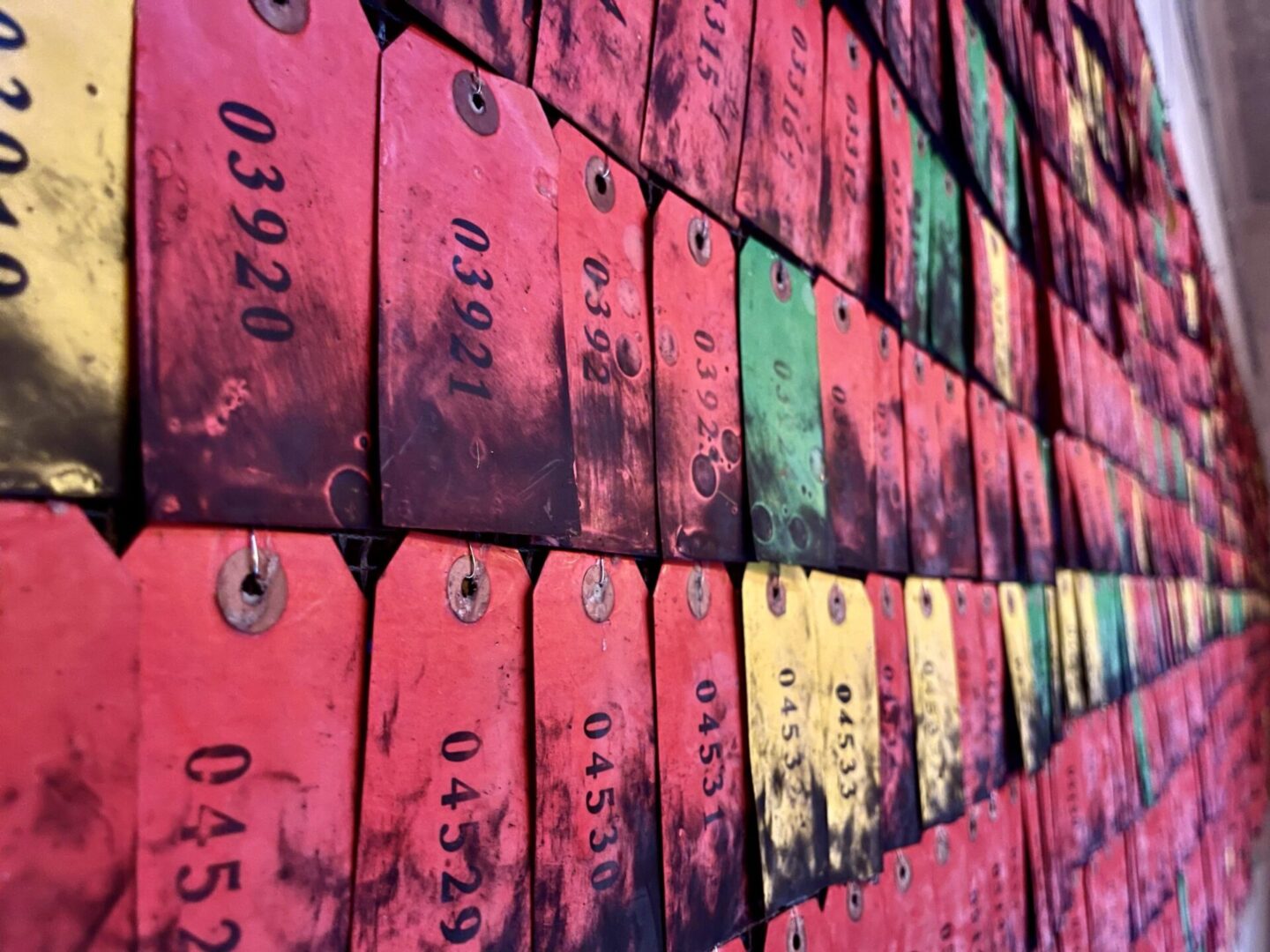
Hidden Heroes stitches and weaves together stories of unsung heroes. Experience compelling mixed-media installations that highlight the contributions made by essential workers during a crucial chapter of Canadian history. Through intricate sculptures made from paper ephemera, paper clay, joss paper, and archival photographs, Hidden Heroes blends historical insights and artistic interpretations to offer a deeper understanding of the Diefenbunker’s role in the Cold War.
Kwan’s work is inspired by his personal lens as a queer, third-generation Chinese Canadian artist, as he explores intersections of the Chinese diasporic experience. You’re encouraged to reflect on diverse narratives of Canadian Forces Station (CFS) Carp staff and other “hidden heroes” during the Cold War era, whose contributions enrich our national story and mirror milestones in Canada’s journey towards equity, inclusion, and diversity.
Listen to our 2024 Artist-in-Residence, Don Kwan, share the inspiration behind his Hidden Heroes exhibition.
Through his lens as a queer, third-generation Chinese Canadian artist, Kwan highlights the powerful stories of the Diefenbunker’s essential workers, whose contributions were crucial during the Cold War era and whose stories reflect Canada’s journey towards equity, inclusion, and diversity.
2024 Artist-in-Residence
We are pleased to announce Don Kwan as our 2024 Artist-in-Residence. Don’s residency will culminate in a multi-sensory, mixed-media exhibition that honours the vital contributions made by the “hidden heroes” at the Diefenbunker during the Cold War — the often-overlooked cleaners, cafeteria staff, maintenance workers, emergency responders, and others who sustained the bunker’s operations against the backdrop of Cold War tensions.
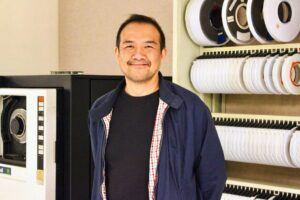 “I am thrilled to have been selected as the Diefenbunker’s 2024 Artist-in-Residence. As a queer, third generation, Chinese Canadian artist with a studio in the Ottawa Valley, this opportunity holds significant personal and artistic resonance for me."
Don Kwan
Celebrating its 10th anniversary this year, the Diefenbunker’s annual Artist-in-Residence Program brings new perspectives to Canadian history, 75 feet underground. Visitors can engage with the artistic representations and immersive stories of hidden heroes when the 2024 Artist-in-Residence exhibition opens in October.
Wind Up Radio, 2023
Cold Comfort for a Hot World
Wind Up Radio, 2023 Artist-in-Residence
October 21, 2023 – February 4, 2024
The Diefenbunker: Canada’s Cold War Museum is pleased to announce its 2023 Artist-in-Residence exhibition, featuring the work of collaborative duo Wind Up Radio, founded by Sarah Blumel and Anisa Cameron.
This multi-part exhibition explores how we cope in the face of an uncertain future, taking inspiration from Cold War preparedness that the Diefenbunker exemplifies. Using satirical music and video compositions that contribute to a long history of musical responses to nuclear war, Wind Up Radio invites us to consider an unlikely truth: that levity and laughter may be possible — perhaps even comforting — in moments of fear and helplessness.
From pandemics to nuclear war, world-scale risks seem to pour over our society daily. How do you cope with our uncertain future?
Original keyboard tunes and lyrics, juxtaposed with clips of civil defence films, offer a satirical view of government directives aimed at citizens preparing for the possibility of a nuclear war. Exhibited throughout the Diefenbunker, these musical compositions embody the spirit of “gettin’ funky in the bunky” — where “funky” can refer to music with a strong dance rhythm AND to a feeling of being terrified.
What better place to experience, simultaneously, a sense of unease and of safety — or “cold comfort” — than the Diefenbunker? It was built during the height of the Cold War as part of a complex government response to the threat of nuclear war. You’ll face terrifying truths as you journey through the exhibition, but you may find yourself humming along to Wind Up Radio tunes as you go.
Cold Comfort for a Hot World opens on Saturday, October 21, 2023, and runs until Sunday, February 4, 2024. Admission to the exhibition is included with general admission to the Diefenbunker (both guided and self-guided tours).
Wind Up Radio extends special thanks to Sean Campbell and the whole team at the Diefenbunker, Ontario Arts Council, DARC, Laura Paolini, Skylee Storm Hogan-Stacey, Ben Hoskyn, Ian Cameron, Charlie Blumel, Samuel Singer, Bernard von Schulmann, Samuel Mercier, Mahtab and Adrien for the Casio keyboard, the Côte Saint-Luc Dramatic Society, and Joy and Eric.

Featured works
Learn more about the historical clips and inspiration for each of these original compositions included in the exhibition.
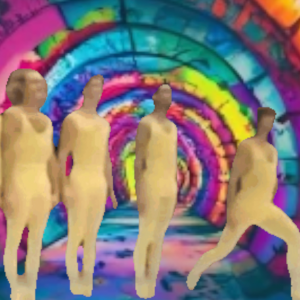
“Joy and Eric/90 Seconds ’til Doom”
Wind Up Radio
Sound and Video
[Learn more]

“Funky in the Bunky”
Wind Up Radio
Sound and Video
[Learn more]
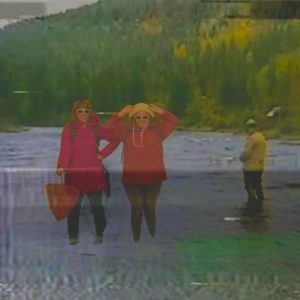
“Just Leave Me Here”
Wind Up Radio
Sound and Video
[Learn more]
Interview with the Artists
About Wind Up Radio
Wind Up Radio creates original music and videos about the things that scare them the most: fire, flood, drought, famine, sentient AI, the breakdown of civilization, aliens, the rich abandoning the Earth for Mars; the future. Oh and also, it’s a good time.
Wind Up Radio was founded by Sarah Blumel and Anisa Cameron. Anisa is a Montréal-based theatre practitioner and real showstopper who is feeling like her “Live, Laugh, Love” days may be numbered thanks to the threat of global economic and environmental collapse. Sarah is a queer, multimedia artist who makes music and video art to quiet the ring of impending doom.
>> Books we like
>> Music we like
Wind Up Radio selected as Diefenbunker’s 2023 Artist-in-Residence
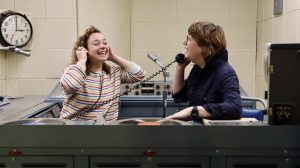
2023 Artist-in-Residence Wind Up Radio collaborators Anisa Cameron and Sarah Blumel in the Diefenbunker’s CBC Radio Room. Image courtesy of the Diefenbunker: Canada’s Cold War Museum.
Ottawa, Ontario, April 26, 2023 — The Diefenbunker: Canada’s Cold War Museum is pleased to announce Wind Up Radio as its 2023 Artist-in-Residence. Through video and original music, this collaborative duo will explore what it means to be prepared in the face of an uncertain future, taking inspiration from Cold War preparedness that the Diefenbunker exemplifies.
The Diefenbunker’s annual Artist-in-Residence exhibitions bring new perspectives on Cold War stories, 75 feet underground in the Bank of Canada Vault. “It is a pleasure to welcome Wind Up Radio underground as this year’s Artist-in-Residence,” says Diefenbunker Curator Sean Campbell. “The Diefenbunker is a living example of the Canadian government’s immense efforts to safeguard the future of our country under threat of a nuclear attack. Wind Up Radio is providing an opportunity for visitors to understand, through a new medium, Canada’s preparedness during the Cold War.”
With the help of a Casio keyboard and the Internet, Wind Up Radio mixes terrifying truths about our collective future with a really good time. Inspired by sounds, images, artifacts, and archival material from the Diefenbunker, they will produce an installation of stitched video footage and original satirical songs to envision what comes next for humanity. “We could not be more excited to work with the Diefenbunker team to uncover treasures from the past that make us consider our future in new ways,” says Wind Up Radio. “We are thrilled to have the opportunity to explore what it means to be ready to face climate change and global economic collapse, by taking a close look at what people did to prepare during the Cold War.”
Wind Up Radio’s diverse experience in theatre, visual arts, music, community organizing, and education have taught them how to connect with the public on ideas that matter. “Art and music provide an emotional gateway to complex problems, and whether you’re packing your go-bag to escape, or running a duck-and-cover drill, nothing is more comforting than humming a little tune.” Wind Up Radio brings a sense of levity to their work, using surprise and delight to help us learn new things. Their installation will seek to engage with visitors on important questions around the uncertainties we face ahead, while addressing the significance of joy for our survival and the role of technology in helping us stay connected and informed during times of crisis.
Wind Up Radio invites us to reflect on Canada’s preparedness during the Cold War as we consider how we might adapt to our changing planet. “While the Cold War is in the past, so many lessons remain relevant today,” says Sean Campbell. “Wind Up Radio takes a creative spin on preparing for the unsettling realities of our ever-uncertain future. We look forward to learning new insights from their work.”
This innovative exploration of Cold War themes will come to life at the Diefenbunker over the course of the year. The final installation will open to visitors in the fall of 2023 as part of the Diefenbunker’s 25th anniversary celebrations.
Christos Pantieras, 2022
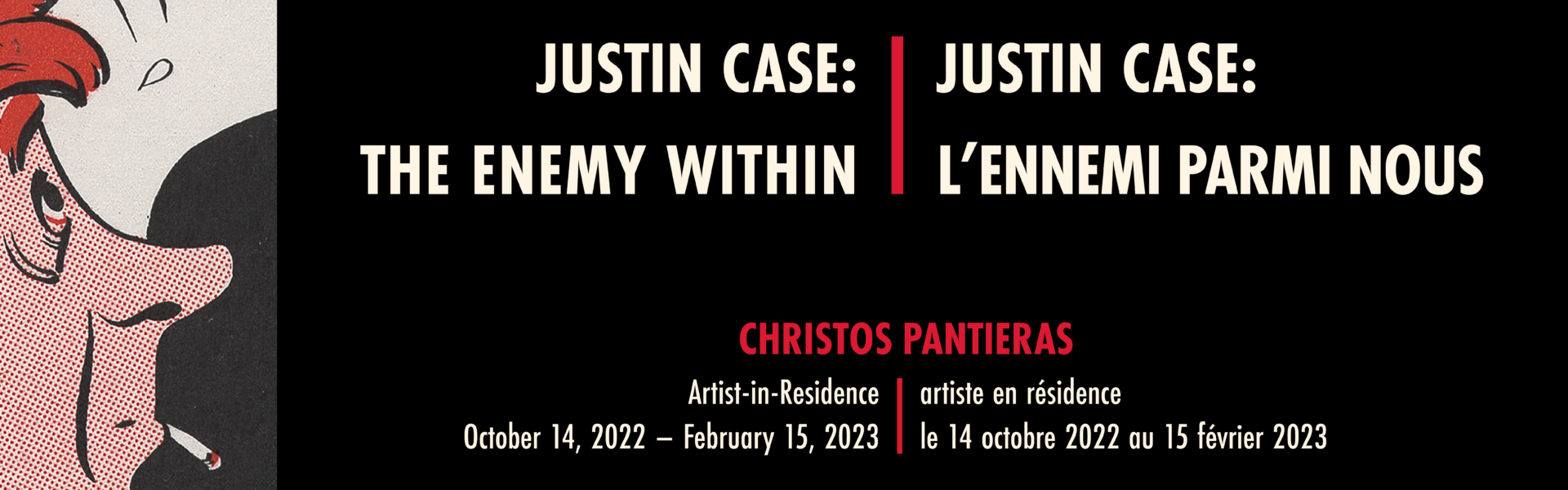
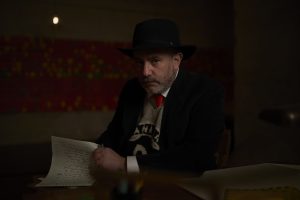
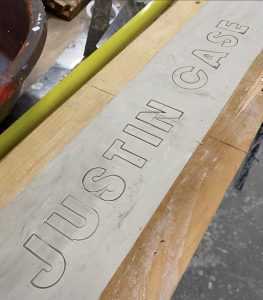
Justin Case: The Enemy Within
Christos Pantieras, 2022 Artist-in-Residence
October 14, 2022 – February 15, 2023 *EXTENDED* to March 3, 2023
The Diefenbunker: Canada’s Cold War Museum is pleased to launch its 2022 Artist-in-Residence exhibition, featuring the work of Ottawa-based artist Christos Pantieras.
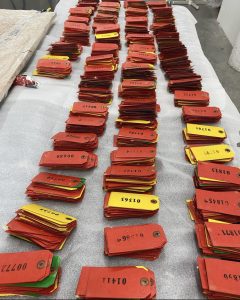
Through a multi-layered installation and a series of reinvented propaganda posters, this exhibition explores the LGBT Purge and the resulting personal struggles of those in the 2SLGBTQ+ community. Pantieras addresses the hidden and “underground” nature of homosexuality in Canada over a period that began in the 1950s during the Cold War and continued up until the mid-1990s.
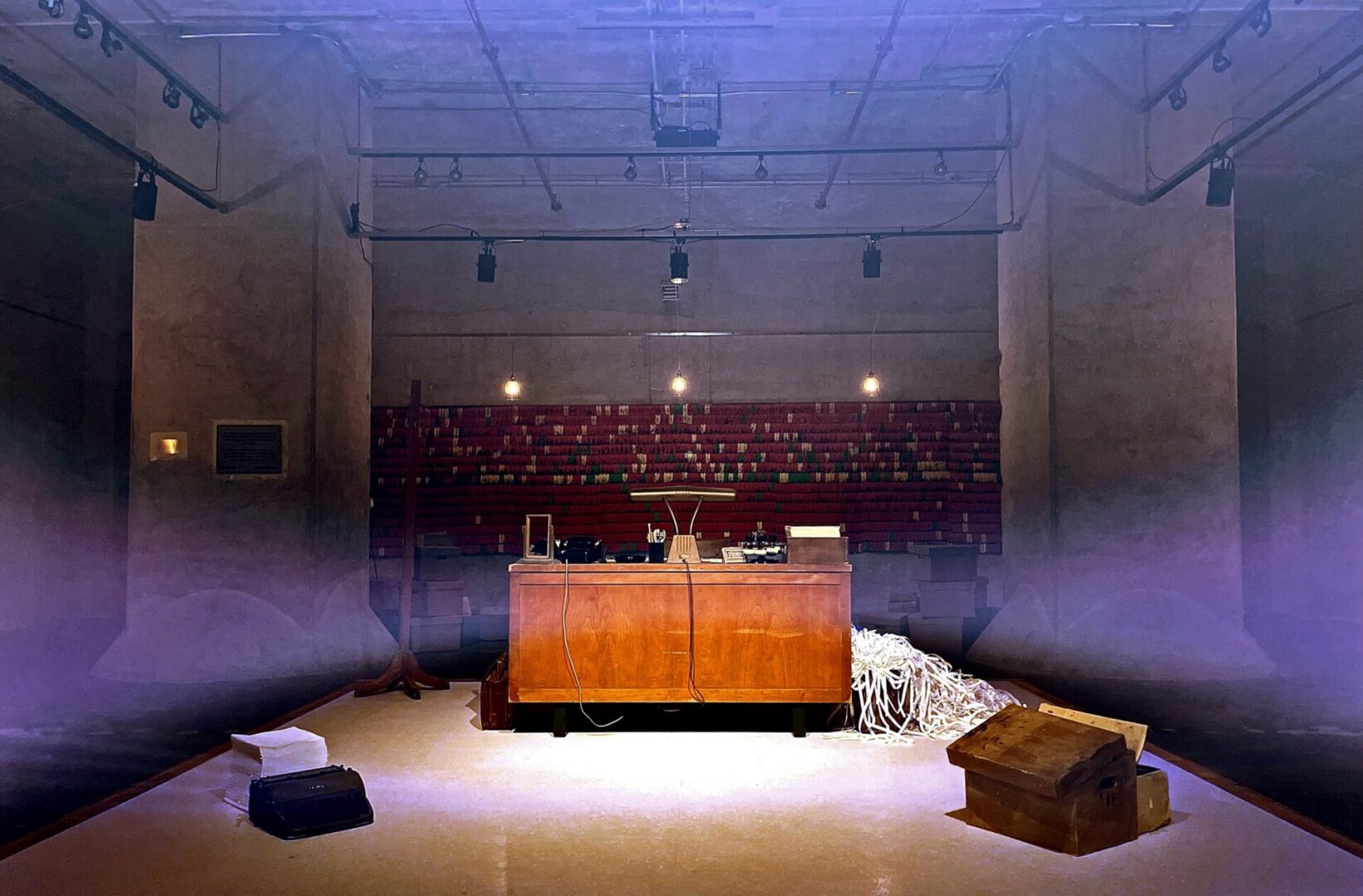
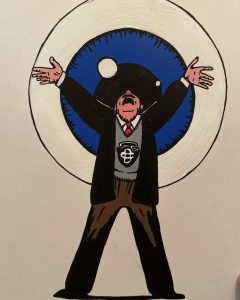
Who is Justin Case and what is his truth? Civil Defence Canada’s comic fictional character Justin Case, originally a mascot to promote preparedness and safety, takes on a new life under cover.
Reimagined as a decorated RCMP Investigator, he is tasked with seeking out and dismissing queer people within Canada’s civil service and Armed Forces. The truth? Justin Case is a closeted gay man who turns double agent to secretly destroy evidence against fellow queers.
Can he save his comrades and keep his own secret?
Justin Case: The Enemy Within opens on Friday, October 14, 2022, and runs until Friday, March 3, 2023. Admission to the exhibition is included with general admission to the Diefenbunker (both guided and self-guided tours).
The LGBT Purge
What if you were deemed a security risk for simply being who you are?
This was the reality for thousands of Canadians who were subjected to what became known as the “LGBT Purge.”
Beginning in the 1950s, during the Cold War, and continuing up until the mid-1990s, Canadian civil servants, RCMP employees, and Canadian Armed Forces personnel who were perceived or discovered to be 2SLGBTQ+ faced systematic discrimination. They were secretly investigated, questioned, and then dismissed because of their sexual orientation, which was considered a “character weakness.”
These traumatic acts continue to impact lives today. Learn more about the LGBT Purge and present-day reconciliation efforts through the LGBT Purge Fund.

Special events
Join us for an Artist Walkthrough!
Meet with artist Christos Pantieras in the Bank of Canada Vault at the Diefenbunker to learn more about the exhibition.
Saturday, November 12, 2022, at 1:00 p.m. and 2:00 p.m.
Sunday, December 11, 2022, at 1:00 p.m. and 2:00 p.m.
Saturday, February 11, 2023, at 1:00 p.m. and 2:00 p.m.
Special appearances by Justin Case!
Witness Justin Case working in his office as he processes cases in his role as an RCMP Investigator during the LGBT Purge.
Saturday, January 28, 2023, at 1:00 p.m.
Sunday, January 29, 2023 at 1:00 p.m.
Saturday, February 11, 2023 at 1:00 p.m.
Sunday, February 26, 2023 at 1:00 p.m.
Stay tuned for updates on future events on our social media.


Credit: Chris Goodyear
Sneak peek



Christos Pantieras acknowledges the support of the Canada Council for the Arts.
Christos Pantieras acknowledges the funding support from the Ontario Arts Council, an agency of the Government of Ontario.
Christos Pantieras gratefully acknowledges the financial support of the City of Ottawa.
A look inside Justin Case: The Enemy Within
Who is Justin Case? What is his secret? Civil Defence Canada’s comic fictional character takes on a new life under cover. Experience Christos’ immersive installation that explores the LGBT Purge and the resulting personal struggles of those in the 2SLGBTQ+ community.
Interview with the Artist
Listen to Christos discuss the inspiration and meaning behind his work — Justin Case: The Enemy Within. He reflects on his research, artistry, and residency and addresses the hidden and “underground” nature of homosexuality in Canada during the Cold War.
Diefenbunker announces Christos Pantieras as its 2022 Artist-in-Residence
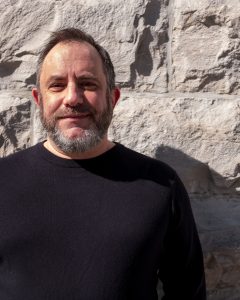
2022 Artist-in-Residence Christos Pantieras. Credit: Mathaios Spanos.
Ottawa, Ontario, March 22, 2022 — The Diefenbunker: Canada’s Cold War Museum is pleased to announce Ottawa-based visual artist Christos Pantieras as its 2022 Artist-in-Residence. In his work, Christos will draw inspiration from the intersection of 2SLGBTQ+ history and experience, to amplify important stories from the Cold War that continue to impact lives today.
Over the course of the year, Christos and the Diefenbunker team will develop and install an exhibition in the depths of the bunker. “We are thrilled to welcome Christos Pantieras underground this year as our Artist-in Residence,” says Courtney Gehling, the Diefenbunker’s Visitor Experience Manager. “Christos is an incredible artist, well-known in the Ottawa community and beyond.” His practice spans large-scale installations, sculpture, and mixed media works.
The annual Artist-in-Residence exhibitions bring new life and stories to the bunker’s concrete walls. Christos states, “I am very excited to be among the exceptional group of artists who came before me. Their varied responses to the Diefenbunker have inspired me to consider how I might push and develop the boundaries of my own art practice.”
Using the Diefenbunker’s collection and archives, Christos will research “Justin Case”, a comic character created by Civil Defence Canada to promote preparedness and safety. “This invaluable opportunity to explore the rich archives and artifacts within the Diefenbunker puts me on a path of invested research into the history and the stories of the 2SLGBTQ+ community,” Christos explains. He intends to reinterpret the role of Justin Case to bring attention to 2SLGBTQ+ perspectives during a difficult period of recent history. “My vision is to present a multi-layered installation reflecting the distrust and personal struggle that grew out of the Cold War paranoia and culminated in the LGBT Purge.”
Alongside “themes of communication and secrecy, of place and belonging, of exclusion and inclusion, and of the hunt and the escape,” this exhibition will seek to address the hidden and “underground” nature of homosexuality and the impacts of the Cold War on the 2SLGBTQ+ community.
The Diefenbunker’s Artist-in-Residence exhibitions provide new ways for visitors to experience and connect with Cold War history. “We are excited to support Christos in his research, approach, and work as it develops, while broadening our interpretation of the collection and deepening our understanding of the stories of the 2SLGBTQ+ community,” says Courtney. We look forward to seeing this installation come to life and welcoming visitors when the exhibition opens in the fall.
Mairi Brascoupé, 2021
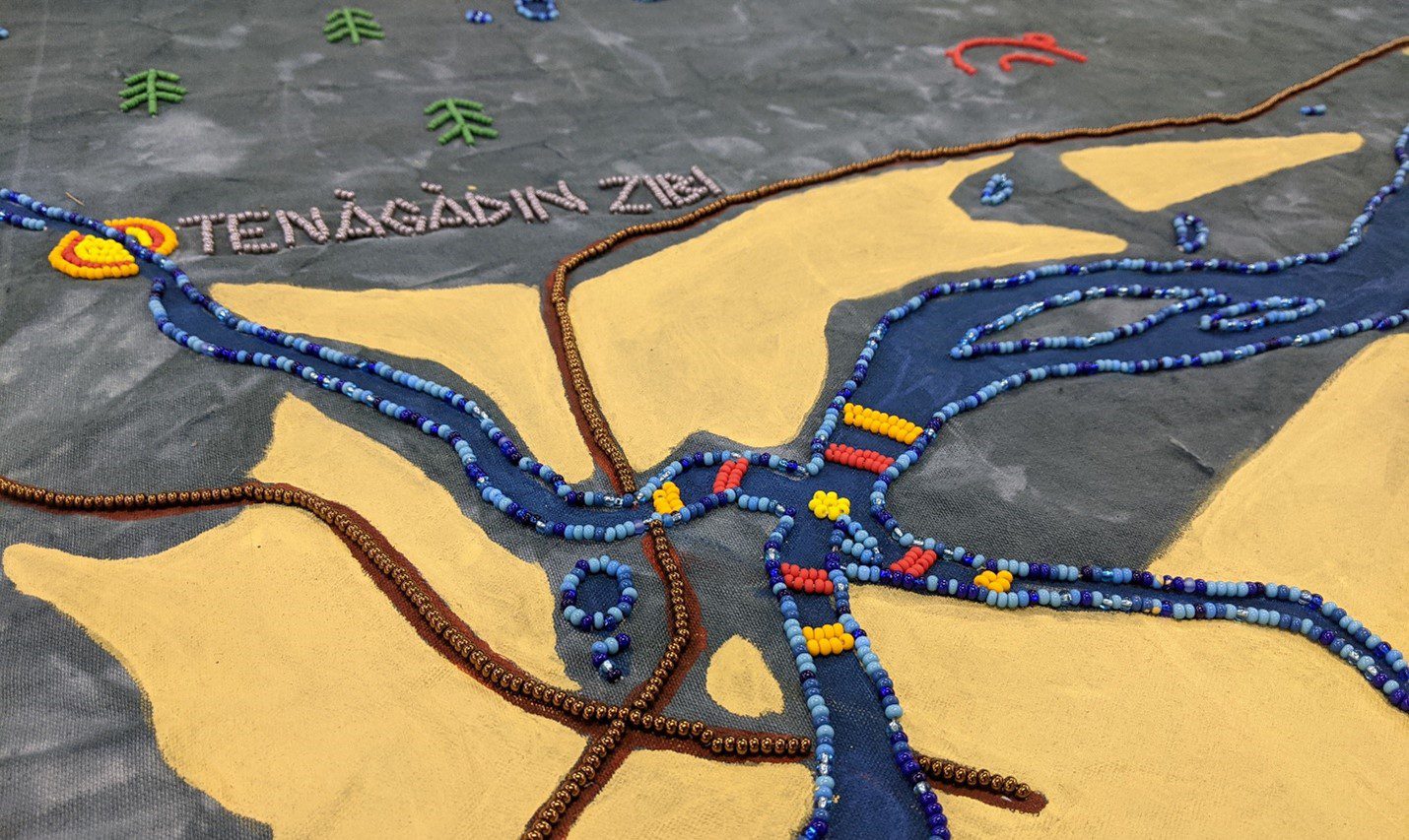
Akìmazinàzowin | An Image of the Land
November 6, 2021 – January 31, 2022 *EXTENDED* to February 27, 2022
Mairi Brascoupé, 2021 Artist-in-Residence
The Diefenbunker: Canada’s Cold War Museum is pleased to launch its 2021 Artist-in-Residence exhibition, featuring the work of Algonquin artist Mairi Brascoupé.
Akìmazinàzowin | An Image of the Land invites us to hear compelling stories of the land and witness history through another lens.
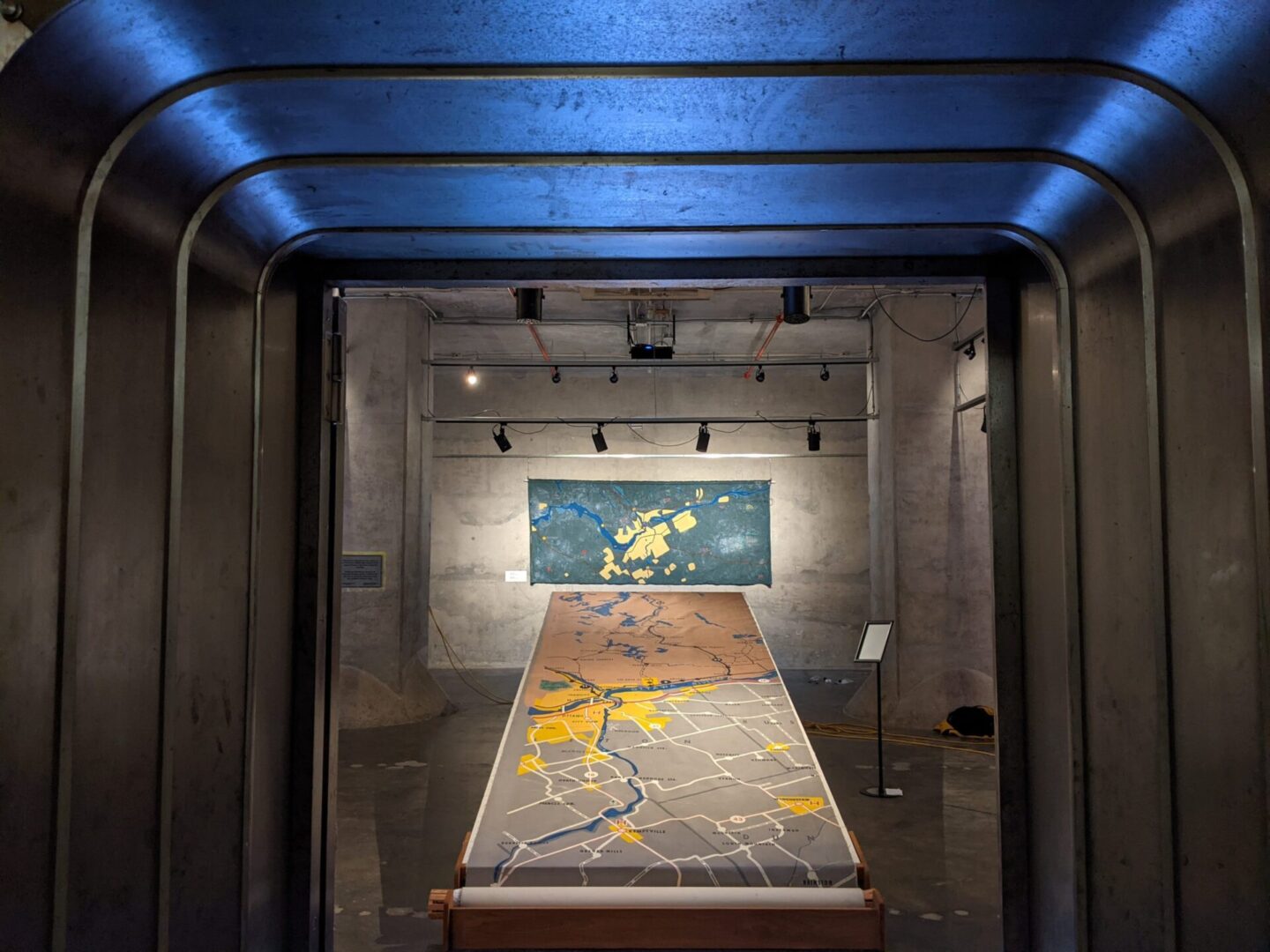
Integrating beadwork into a map of the region as it exists today, the artist invites us to explore our understanding of place during times of change and uncertainty, and to look at how values may differ, specifically for Indigenous peoples. How can we strive for a future that brings our different perspectives into alignment?
Akìmazinàzowin | An Image of the Land opens on Saturday, November 6, 2021. Admission to the exhibition is included with general admission to the Diefenbunker (both guided and self-guided tours).
Making Akìmazinàzowin
Watch Mairi share her creation process for her beautiful beadwork — important waterways, pathways, animals, and plants beaded onto a 12-foot by 5-foot canvas map of the Ottawa region as we know it today. Her work invites us to witness Cold War history through an Indigenous lens.
Interview with the Artist
Listen to Mairi discuss the inspiration and meaning behind her work — a beaded canvas map of Algonquin territory. She reflects on her research, artistry, and the residency, and shares some of the key concepts and traditional knowledge that are integrated into her piece.
The Diefenbunker announces Mairi Brascoupé as its 2021 Artist-in-Residence
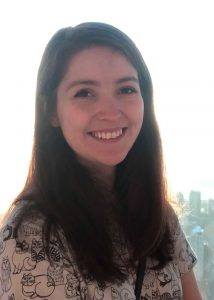 Ottawa, ON (June 21, 2021): The Diefenbunker: Canada’s Cold War Museum is thrilled to announce Algonquin artist, Mairi Brascoupé, a member of Kitigan Zibi Anishinabeg, as its Artist-in-Residence for 2021. Mairi hopes to explore our understanding of place during times of change and uncertainty and how values differ, specifically for Indigenous people, through mapping and remapping during Canada’s Cold War history. Mairi will conduct research on the maps created during the Cold War and the maps that exist in the Diefenbunker. She will focus on mapping waterways and traplines in contrast with fallout zones, evacuation plans, and Military Town Plans. By integrating these maps with beadwork, Mairi says these new maps will “move across time and space, from what was, is, and could be.” The aim of this discussion will be “how our values connect and collide” and “how we can strive for a future that brings these perspectives into alignment.”
“We’re keenly interested in what Mairi has to bring to the Diefenbunker,” says Sean Campbell, the museum’s Visitor Experience Manager. “Her unique perspective will invite a lot of conversation on topics that are not often brought up with regard to Cold War history.”
Mairi Brascoupé sees “preservation in the Diefenbunker” as a focus for the residency: “I am inspired by the desire to preserve life, culture, and society that can be seen throughout the Diefenbunker. This is something that I aim to do in my own artistic practice by engaging in traditional Indigenous craft and stories, so that our culture is preserved for generations to come.”
In particular, Mairi will examine how storytelling can cross different media, and how the perspective of the story changes with these crossings. “I am particularly fascinated by all the different maps around the Bunker and how they all serve a purpose to educate, prepare, and preserve important information of the time they were created. Beadwork is used as a way to tell stories and preserve a moment in history. By bringing an Indigenous lens to maps, placekeeping, and placemaking through beadwork and historical maps, I hope to reframe how we look at the land, ownership, and responsibility.”
We are very excited to see what she will create, inspired by our recent past, present, and future. Stay tuned for updates about Mairi Brascoupé’s residency.
View the full Press Release (English & French).
Greta Grip, 2020
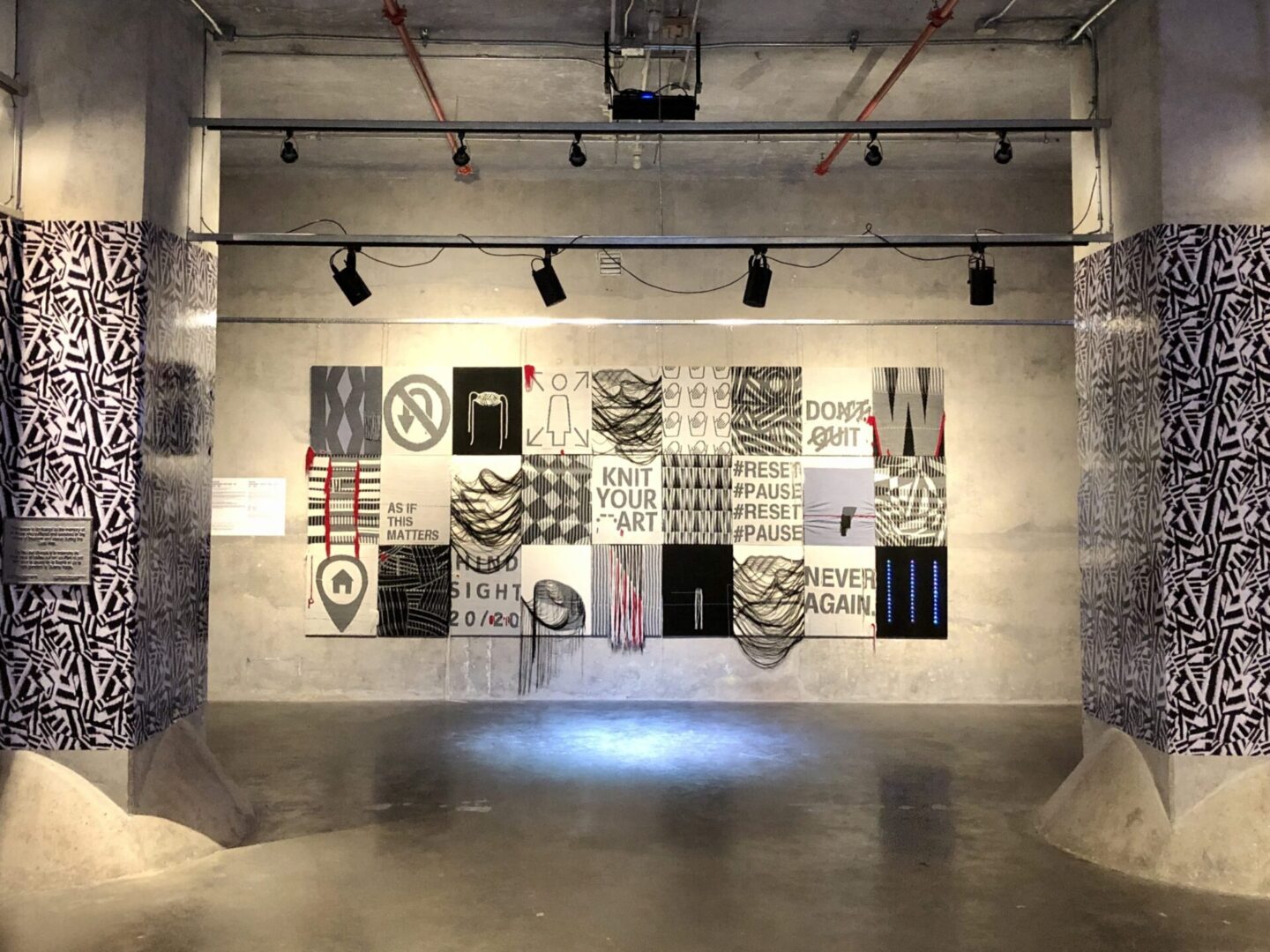
CONTAINMENT: KNIT YOUR .--.ART
GRETA GRIP, 2020 ARTIST-IN-RESIDENCE @DIEFENBUNKER
October 15, 2020 until March 7, 2021
VIRTUAL VERNISSAGE VIDEO RELEASE
Videos from the October 15 Q&A with the artist, Greta Grip, and our Visitor Experience Manager, Courtney Gehling. (Also an Instagram LIVE FEED).
PART ONE
PART TWO
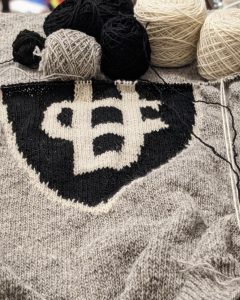
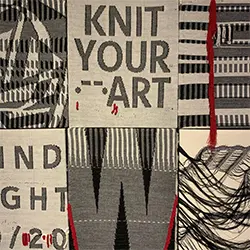 It was the cold and concrete spaces of the Diefenbunker that inspired 2020 Artist-in-Residence Greta Grip to bring the warmth of knitting to its walls. This underground bunker, commissioned amid the anxiety and uncertainty of the Cold War years, was built to protect, preserve, and nurture the few who would carry on for the greater good in the event of a nuclear attack. Grip parallels the purpose and procedures of the Diefenbunker with those of knitting — something individuals do to contribute to wartime efforts and social causes, or to build community in difficult times. Both the bunker and the knitted items provide protection and comfort.
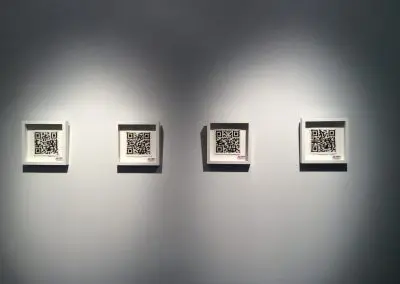
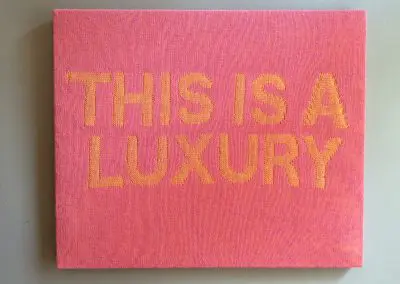
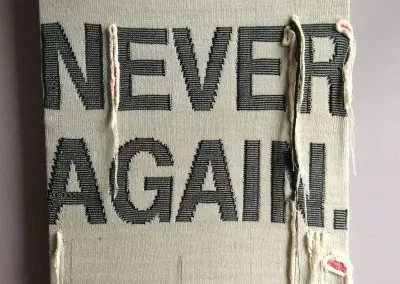
Code is essential to the Diefenbunker (an operational communications centre) and to the act of knitting: both use code to create, embed, decipher, and communicate covert messages. Like the dots and dashes of Morse code and the 0s and 1s that symbolize binary code used in digital computers, knitting relies on two basic states: knit stitch and purl stitch. Grip’s work, which ranges from code messages, icons, and QR codes, all created by hand or using a hacked knitting machine, shows us how knitting itself weaves in and out of what can be read and what is hidden.
This residency took place from January to September 2020, while much of the world sheltered in place, struggling to cope with and understand the Coronavirus disease (COVID-19). Largely influenced by the realities of this period, Grip’s work reflects on themes of containment, protection, health and safety, public messaging, community, and contribution, which are as evident today as they were during the Cold War.
Knitting as Espionage: The Diefenbunker announces Greta Grip as its 2020 Artist-in-Residence
 The Diefenbunker, Canada’s Cold War Museum is thrilled to announce artist, Greta Grip, as its Artist-in-Residence for 2020. Greta Grip is fascinated with code. From reading coded knitting patterns to knitting acronyms and QR codes, to hacking a knitting machine; knitting itself weaves in and out of what can be read and what is hidden. The history of espionage has knitting hidden as a facilitator of secrets. Her residency at the Diefenbunker will include researching, deciphering, and creating knitting as code.
“We’re really looking forward to welcoming Greta underground once we reopen,” says Courtney Gehling, the Diefenbunker’s Visitor Experience Manager. “Her incredible artwork and the theme of knitting as code make her the perfect fit for the museum.”
Greta Grip explains her inspiration, “The cold and sterile space at the Diefenbunker has inspired me to bring the warmth of knitting to its walls. The bunker having its origins in uncertain times: to protect, to keep safe, to rebuild is similar to the act of knitting which is often nurturing, providing shelter as well as creating a sense of community but also it is often an isolating act. Both the Diefenbunker and knitting are both entrenched with codes: deciphering, hiding and creating, of which I will be expanding on during the residency.”
While the current COVID pandemic has shifted Greta’s focus to creating for an important cause, our frontlines, we have been thinking of different ways to bring her residency to life in the future. She says, “I am interested to exhibit in the Bank of Canada Vault, as it was built to safeguard Canada’s gold standard in order to rebuild the country after nuclear attack. Fitting for today’s climate, we are not under nuclear attack but we are faced with rebuilding the country.”
We are very excited to see what she will create, inspired by our recent past, present, and future. Stay tuned for updates about Greta Grip’s residency.
View and download the Press Release here (pdf).
Carol Wainio, 2019
Disasters for Little Children, an exhibition by the Museum’s 2019 Artist-in-Residence, Carol Wainio.
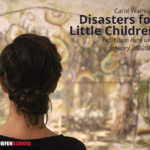
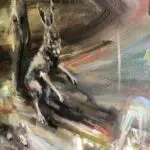
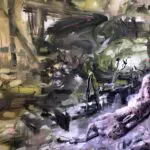
In this exhibition, artist-in-residence Carol Wainio uses fairy tales to explore current and past fears. Even the most beloved children’s stories are full of calamity and insecurity. Only sometimes does being clever and prepared to win the day.
Wainio created Disasters for Little Children specifically for the Diefenbunker. The bunker’s construction and design prompted memories of the Tale of the Tortoise and the Hare. Above ground, the protective building reminded her of a turtle’s shell. The underground level, with its hallways and small rooms, seemed like a rabbit’s warren.
Wainio researched Cold War emergency preparedness materials while creating these artworks and discovered Bertie the Turtle, a cartoon character who advised children to “duck and cover” in a nuclear attack – an impossibly naive protection. In contrast, the concrete and steel Diefenbunker would have housed top decision-makers so they could plan for a post-war future. Despite this protection, there were no families here, no next generation of humanity. Deep underground during a nuclear winter, children’s tales of forests and animals would have seemed very far away and long ago.
During the Cold War, nations competed to develop weapons of mass destruction. As in the arms race, the fabled Hare and Tortoise sped toward an uncertain end. Today, we move closer to the slower catastrophe of climate change. Through paint, photography, illustrations, and children’s drawings, Wainio reveals a not-so-fairy-tale world of opposites: then/now, fast/slow, arrogance/persistence, and destruction/survival.
2019 Announcement
 Ottawa-based multi-award winning artist, Carol Wainio, selected as Diefenbunker Museum’s 6th Artist in Residence. It is our privilege to announce that Carol Wainio has been selected as our 2019 Artist-in-Residence.Carol’s work draws together diverse references to investigate and re-stage older visual narratives of transformation and desire, scarcity and excess, often, though not exclusively, drawn from early European fairy tale.
“My work has explored various forms of vernacular and popular imagery in the context of history and narrative, including archival research in historical fairy tale illustration. Fairy tale characters and narratives were also used in the 19th century to sell products and in popular political commentary and imagery. Some of these pre-modern tales seem increasingly relevant as metaphors for migration, certain political issues, or in the context of post Cold War, contemporary forms of possible catastrophe (environmental, economic).”
Carol is currently a professor at The University of Ottawa in the Visual Arts Department. She has been featured in galleries across Canada and the world. Her work has been shown at the the National Gallery of Canada, the Glenbow Museum, Musées des beaux arts de montréal, and the Art Gallery of Ontario, as well as several international galleries.
“I plan to explore the cultural aspect of cold war fears in terms of their expression whether through posters, popular imagery, and other artifacts, with a view to finding whether there were similar echoes or uses of fairy tale or cautionary tale.”
Annette Hegel, 2018
September 20 to November 30, 2018
The Diefenbunker: Canada’s Cold War Museum presents Now You See Me, an exhibition by the Museum’s 2018 Artist-in-Residence, Annette Hegel.
Ottawa-based multimedia artist, Annette Hegel, selected as Diefenbunker Museum’s 5th Artist in Residence The Diefenbunker Museum is delighted to announce the results of its Artist in Residence for 2018. Annette Hegel, a multi-media artist who has exhibited her work in Canada and Europe, was selected from several applications from both national and international artists. “We’re really looking forward to having Annette at the Museum,” said Nic Clarke, the Diefenbunker’s Curatorial Manager. “Both her work and as well as her experiences growing up on the frontlines of the Cold War, make her an amazing fit for the Diefenbunker.” “It is a great honour, to be selected and join the ranks of artists in residence at the Diefenbunker,” says Hegel. “For me, particularly, as a politically engaged artist, research and refelction at the Museum cannot come at more opportune time, considering the world-political climate of the last 24 months that should give a certain sense of déja-vu to those of us who have come of age during the Cold War.” Annette grew up in Cologne and Düsseldorf, West Germany and moved to Toronto in the early 1980s to study at the Ontario College of Art (now OCAD University) in the experimental arts department. She returned to West Germany in the mid-eighties and moved to West Berlin at a time of great cultural and political flux that eventually led to the fall of the Berlin Wall in 1989. She co-founded the artist collective that ran the “Weiße Gallerie” (White Gallery), a group of artists that made it their focus to comment on the plethora of political and social issues of the decade that were amplified by the circumstances of Berlin’s role in German and World politics. Annette moved back to Canada in 1987 and is now based in Ottawa, where she was founding member of the Slipstream Collective in 2014. In addition to being a member of the Slipstream Collective, Annette has been a catalyst and facilitator of many community-based public art projects, particularly engaging children and youth. As well as her daily art practise, Annette is engaged in the ongoing collaborative trans-atlantic project “HEGEL,HEGELcontemporary,” which is an experimental visual dialogue with her curator brother Martin who lives and works in Cologne.
Pixie Cram, 2017
July 20, 2017 to October 29, 2017
The Diefenbunker: Canada’s Cold War Museum presents Emergency Broadcast, an exhibition by the Museum’s 2017 Artist-in-Residence, Pixie Cram. The piece is a seven-minute, stop-motion production that explores the idea of what would happen in a fallout scenario. The production was filmed entirely within the Diefenbunker, including use of props and sound effects, and integrated audio clips from the US Civil Defense archives and the CBC Emergency Broadcast.
Along with its screening at the Diefenbunker, the exhibition was featured as part of the 2017 Canada Scene Festival with the National Arts Centre. The film was also broadcast on CBC (Absolutely Ottawa) in September 2017. After that, Emergency Broadcast went on to have a very successful international festival run.
Pixie Cram is a filmmaker based in Hull, Quebec. Her productions include fiction, animation, documentary and installation. Pixie studied theater and screenwriting at Concordia University in Montreal before making her film debut. She is co-founder of Windows Collective, a group dedicated to the creation and presentation of experimental works using the film. In addition to her own artistic practice, she works freelance as a director, editor and director of photography. “Since 2000, I have made experimental films and videos using, among other things, animation techniques in volume, puppet animation and real-life shooting, in formats such as super- 8, 16 mm and digital video. I created works of fiction, documentaries and film installations in situ with Windows Collective, a group I founded with Roger D. Wilson in 2008. The vision of the collective is to play with the aesthetics of residential and commercial architectural structures in Ottawa and to reinvent a practice of contemporary mobile urban art stemming from the tradition of cinema. I describe my style as “rustic futurism”, where systems and machines are largely broken and nature inspires a new approach to old issues – a sort of pastoral science fiction.”
Anna Frlan, 2016
September 18, 2016 to January 31, 2017
The Diefenbunker: Canada’s Cold War Museum presents The Age of Atomic Anxiety, an exhibition by the Museum’s 2016 Artist-in-Residence, Anna Frlan.
“There is something fascinating about going into a building that was once so top secret that very few people had seen it, and even the people who worked there were not familiar with all the areas of the bunker,” said Frlan in a recent article for Canadian Art. Following months researching a wide range of subjects about the Cold War through the Museum’s collection, archives, blueprints, photos and library, Frlan has created a series of sculptures that explore the psychological climate during that era. Occupying several spaces throughout the four storey underground facility, Frlan’s highly detailed works offer a unique perspective on one of the most critical times in the world’s history.
“This is my first experience as an artist-in-residence and my hope is to successfully create sculptures that merge research with artistic vision,” wrote Frlan in another recent article for the Ottawa Arts Council, “And if I’m lucky, the public may, through my sculptures, sense what I have discovered at the Diefenbunker so far – the futility of trying to survive a nuclear war, yet being unable to ignore this constantly looming threat.”
Anna Frlan is a sculptor of steel, dedicated to transforming this surprisingly pliable material through a process-oriented studio practice. The daughter of Croatian émigrés, her recent work has explored the connection between industrial steel and twentieth-century weaponry production. Frlan holds a Bachelor of Fine Arts from the University of Ottawa. Her work has been exhibited in solo and group exhibitions in Ottawa, Aylmer, Toronto and Croatia, and is found in the collections of the City of Ottawa, Nortel Networks, Deloitte & Touche, and the Canadian Medical Protection Association.
This project is funded in part by a grant from the Community Foundation of Ottawa, and by an award from the Corel Endowment for the Arts administered by the Ottawa Arts Council.
Jesse Stewart, 2015
July 9 to December 31, 2015
The Diefenbunker: Canada’s Cold War Museum presents Geometries and Auralities of Survival, an exhibition by the Museum’s 2015 Artist-in-Residence, Jesse Stewart.
“Vertical lines painted on the circular concrete pillars that jut out into the hallways…red stripes painted on doors…concentric circles drawn on maps to indicate the projected survival rates as we move further from the epicentre of a nuclear explosion”. Jesse Stewart was struck by a “visual emphasis on modernist geometric designs” throughout the 100,000 square foot facility. These “geometries” are explored in Stewart’s residency exhibition through photography and the introduction of artifacts from the Museum’s collection. The exhibition also incorporates sound through the documentation of performances and sound installation throughout Stewart’s ten month residency.
On the occasion of his exhibition launch, Jesse Stewart will present a free percussion performance in the Museum’s historic cafeteria.
Jesse Stewart is an award-winning composer, musician, visual artist, sound artist, instrument builder, writer, and educator dedicated to re-imagining the spaces between artistic disciplines.
His music has been performed at festivals throughout Canada, the United States, and Europe and is documented on over 20 recordings. He has been widely commissioned as a composer and artist.
He has exhibited visual art in over a dozen solo and group exhibitions at public and private galleries including the Museum of Contemporary Canadian Art, the Karsh Masson Gallery, the Robert McLaughlin Gallery, the Thames Art Gallery, the Glenhyrst Art Gallery, the Peterborough Art Gallery, and the Macdonald Stewart Art Centre.
He is the recipient of numerous awards and honours including the 2012 Instrumental Album of the Year Juno Award for his work with genre-defying trio Stretch Orchestra. In 2014, he was named to the Order of Ottawa, one of the city’s highest civic honours. He is an Associate Professor of music at Carleton University and an adjunct faculty member in the department of visual arts at the University of Ottawa.
Gail Bourgeois, 2014
April 26 to September 28, 2014
The Diefenbunker: Canada’s Cold War Museum is proud to present the first exhibition of its inaugural Artist-in-Residence Program. To warn other Canadians is the outcome of Gail Bourgeois’ artist residency at the Museum and National Historic Site.
“This type of program allows for deeper reflection based on prolonged exposure to the site, it’s messaging, and it’s people”, said Diefenbunker Executive Director, Henriette Riegel. “Gail has gained profound and intimate knowledge of the Diefenbunker through extensive research in her six months here, consultation with our archives, and knowledge of the construction, engineering and architecture of this unique underground piece of industrial heritage. Gail’s art has been created specifically for the Diefenbunker and as a direct response to her experience here.”
Artist Statement
To warn other Canadians is a research and exhibition project that will present art works among the museum’s exhibition spaces. The title is borrowed from something said by tour guide and museum Collections Manager, Doug Beaton: The bunker was here to warn other Canadians. This refers to the role the bunker played in housing elements of the federal government in the event of a nuclear attack.
Signals are a human element. The Cold War, a sustained state of global political and military tensions between East and West Blocs of power, is often given beginning and ending dates that nicely contain a still existing nuclear threat. Named by George Orwell after the dropping of the first atomic bombs in 1945, “cold war” describes the experience of nuclear destruction held in delicate suspension by the avoidance of direct military combat. The atmosphere of fear and suspicion of the post-war period has re-emerged in the form of an unseen but keenly felt enemy. My reflection on this takes the form of art pieces meant to create a space for reflection; another look at what is familiar.”
Artist Bio
Gail Bourgeois holds an MFA from Concordia University. She is a founding member of Powerhouse Gallery (La Centrale) in Montreal and founded or formed part of a dozen artists’ collectives. Her multidisciplinary practice is drawing-based. Her themes and methods of working express the tension between academic knowledge and more experimental forms of knowledge based on her interest in collective practices and community engagement.