
Construction of the Diefenbunker took place between 1959 and 1961, under the code name Project Emergency Army Signals Establishment (EASE). This top-secret project was to design a site that would serve as a communications headquarters for the Canadian government and military in the event of a nuclear attack.
Was Soviet intelligence monitoring the Diefenbunker before it was even finished?
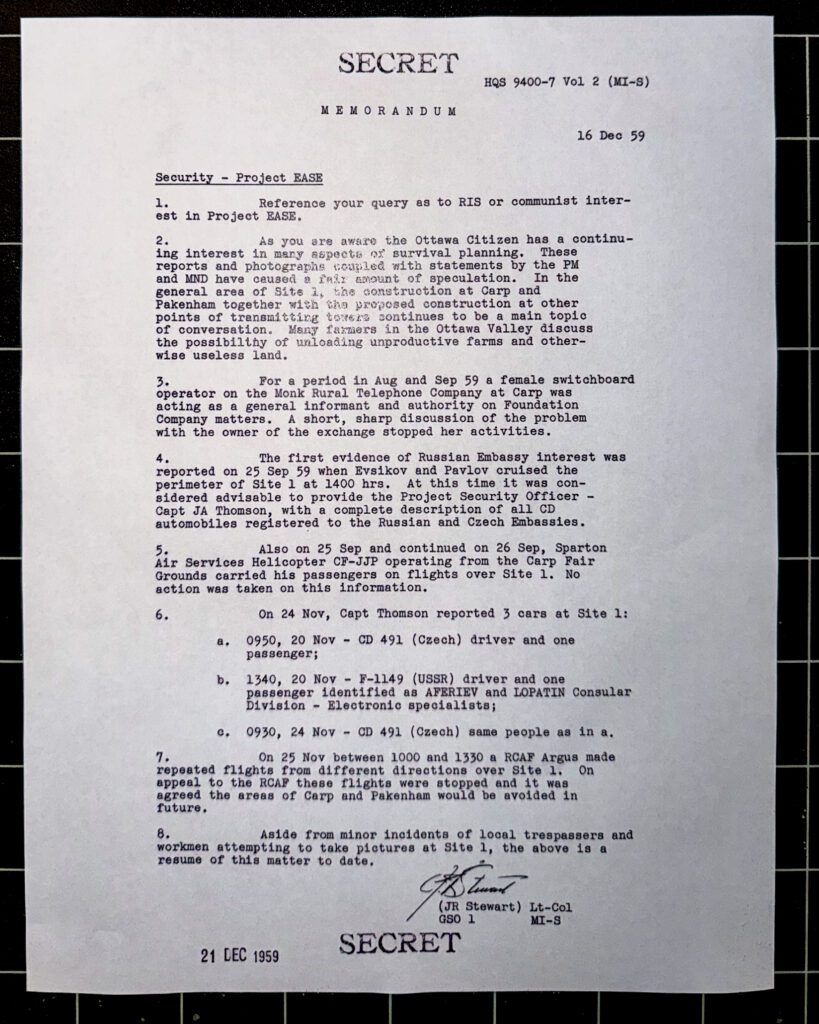
Documents from the Diefenbunker’s archives offer a glimpse into Soviet interest in the top-secret construction project, including reports of Soviet officials observed near the site in 1959. A secret military memorandum dated December 16, 1959, titled “Security — Project EASE,” documented several incidents involving the security of the construction site in Carp, including visits by Soviet and Czechoslovak diplomatic personnel.
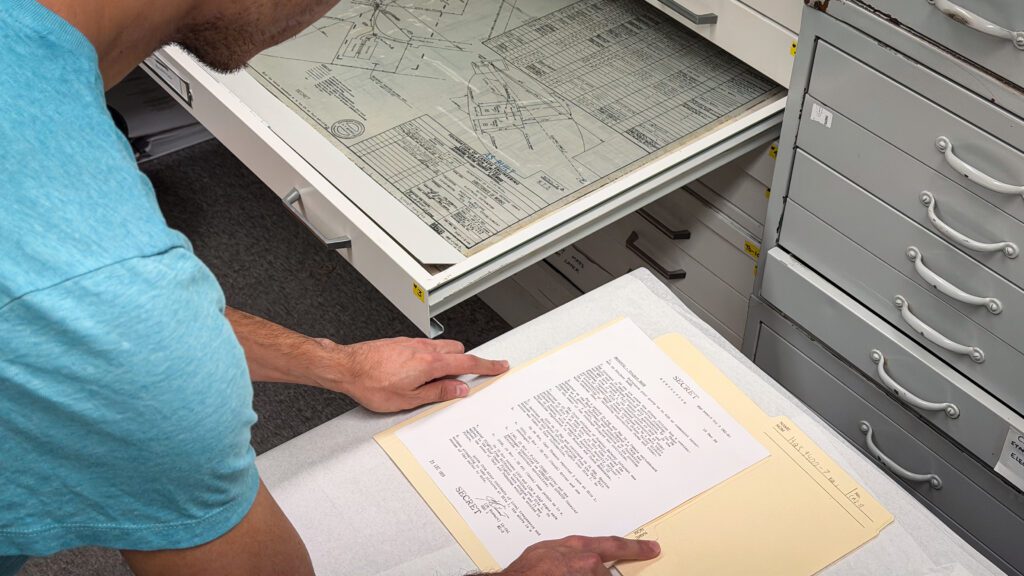
Soviet officials observed at the site
The first recorded indication of Soviet interest occurred on September 25, 1959. At approximately 2:00 p.m., two Soviet Embassy personnel, identified in the memorandum as Evsikov and Pavlov, were observed driving around the perimeter of the construction site.
CIA reference material identifies Colonel Nikolai Vasilyevich Evsikov as the Soviet military attaché in Canada and Captain Aleksandr Gavrilovich Pavlov as an assistant military attaché. Evsikov had previously served in the GRU, the Soviet military intelligence service, and was posted to Canada from 1956 to 1960.
“The first evidence of Russian Embassy interest was reported on 25 Sep 59 when Evsikov and Pavlov cruised the perimeter of Site 1 at 1400 hrs.”

Source: Diefenbunker Museum Archives
Further sightings were recorded in November of the same year.
On November 20, a Czechoslovak diplomatic vehicle, registered as CD-491, was observed at the Project EASE construction site. Later that day, a Soviet vehicle, F-1149, was also observed. The memorandum identified the occupants as Aferiev and Lopatin, described as electronics specialists in the Soviet Consular Division.
The report stated:
“1340, 20 Nov – F-1149 (USSR) driver and one passenger identified at AFERIEV and LOPATIN Consular Division – Electronic specialists.”
The same Czechoslovak vehicle was recorded at the site again on November 24.
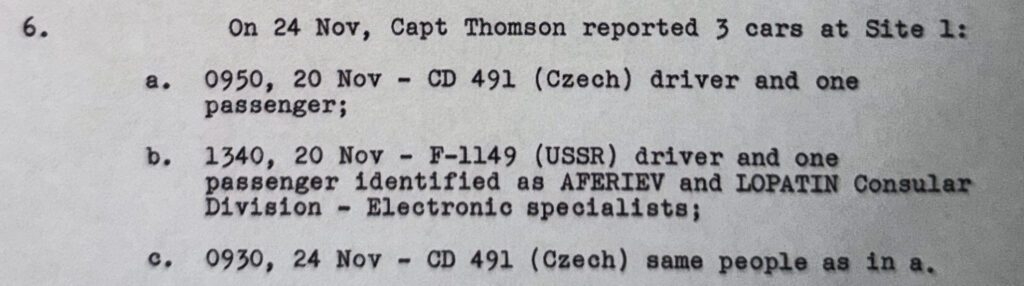
Source: Diefenbunker Museum Archives
Other security concerns
The December 1959 memorandum documented several additional security concerns during the construction of Project EASE. These included civilian helicopters flying over the site, local trespassers, and construction workers attempting to take photographs.
Unauthorized photography by construction workers was considered a potential security risk because photographs could reveal information about the project. At the same time, photographs and film were also produced by authorized parties as part of the legitimate documentation of the bunker’s construction.
Local suspicions
By September 1961, as construction was nearing completion, the secrecy surrounding Project EASE was also a subject of discussion among residents of Carp.
In an article published by the Toronto Telegram on September 11, 1961, Carp residents Louis Hupe and Noreen Armstrong expressed their suspicions about Soviet intelligence activity at the site.
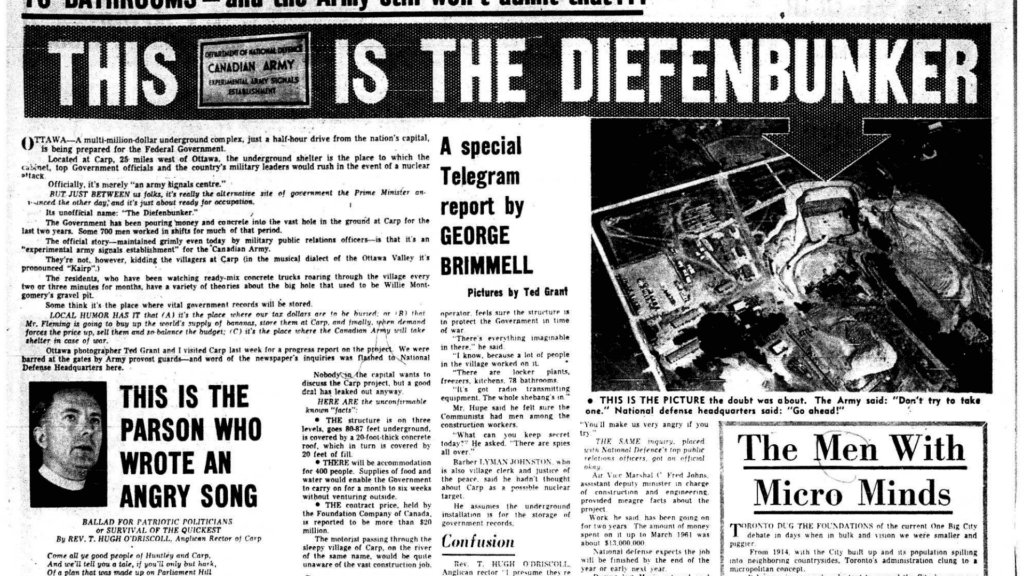
Toronto Telegram, 1961
Source: Diefenbunker Museum Archives
Hupe, a machine shop operator, told the newspaper that he believed Communist agents had been among the people working on the construction site: “Mr. Hupe said he felt sure the Communists had men among the construction workers.”
He added: “What can you keep secret today? . . . There are spies all over.”
Armstrong, a student radiologist, expressed a similar view: “No matter how secret they tried to keep it, I think the Russians had men in there.”
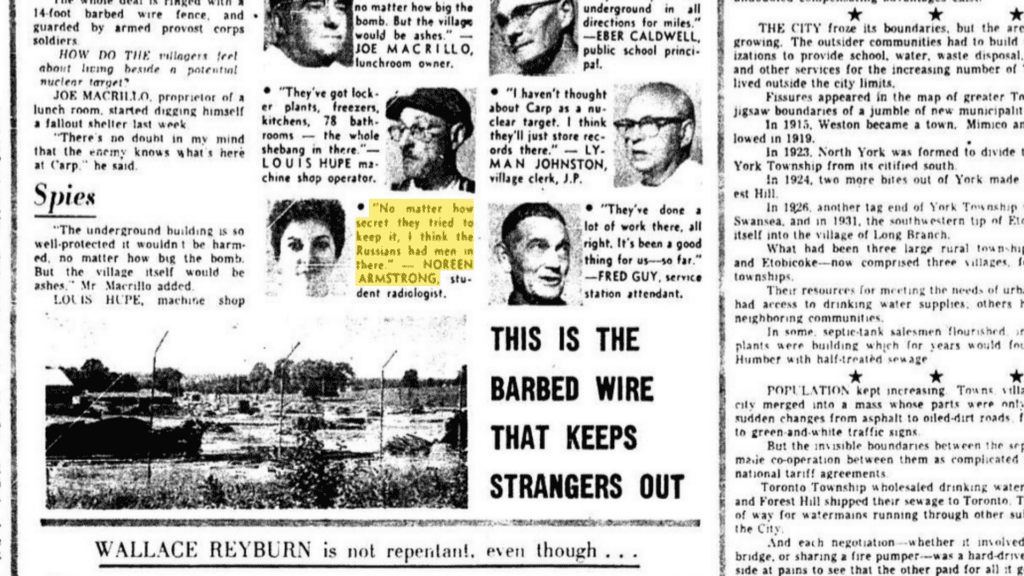
Source: Diefenbunker Museum Archives
While these comments document suspicions expressed by two Carp residents in 1961, they do not necessarily confirm that Soviet agents were present among the construction workforce.
The December 1959 security memorandum, however, provides documented evidence of Soviet and Czechoslovak diplomatic personnel observing the construction site, along with other security incidents that occurred from the time.
This document is just one example of what we can uncover in the Diefenbunker’s archives. Through records, photographs, and other historical materials, we can gain a better understanding of the people, events, and concerns that shaped the Diefenbunker’s history.
Source: Diefenbunker Museum Archives