
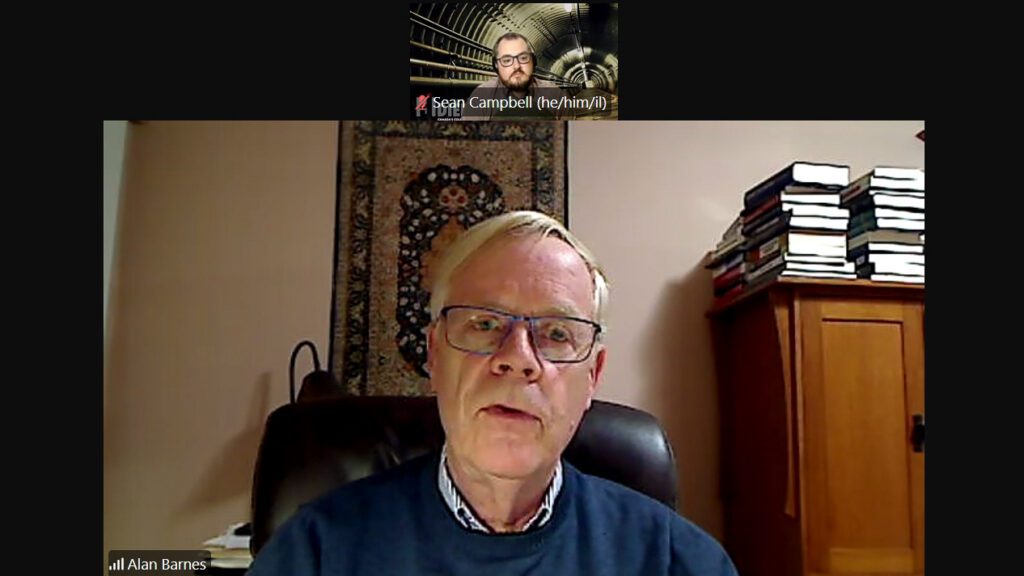
On Thursday, October 15, the Diefenbunker welcomed Alan Barnes for a presentation on Canadian intelligence during the early Cold War. Barnes, author of Watching the Bear: Canadian Intelligence Assessments of the Soviet Threat to North America, 1946–1964, explored how Canada assessed the Soviet threat, worked with American intelligence agencies, and used intelligence to inform defence decisions.
Building Canada’s intelligence capabilities
During the Second World War, Canada relied heavily on its allies for foreign intelligence. After the war, the country recognized the need to develop its own capacity to gather information and assess potential threats.
The Joint Intelligence Committee brought together military intelligence, the Department of External Affairs, and the Royal Canadian Mounted Police (RCMP). Later, a newly formed Joint Intelligence Bureau later expanded Canada’s ability to gather geographic and economic intelligence.
These developments helped Canada bring information from different sources together into strategic assessments for military and political leaders.
The Soviet Union became Canada’s primary perceived threat after the Second World War. However, gathering reliable information about Soviet military capabilities was difficult. With Soviet communications hard to intercept and interpret, analysts relied on diplomatic reporting, military attachés, news coverage, and information from defectors.

Assessing the Soviet threat
Canada worked closely with the United States to assess threats to North America. By the late 1940s, the two countries had established procedures for producing annual joint intelligence assessments, bringing together information and analysis from both sides.
A major concern was the Soviet Union’s development of nuclear weapons and long-range bombers capable of reaching North America. After the Soviet Union tested its first atomic bomb in 1949, assessing its military capabilities became even more urgent.
American assessments often presented a more alarming picture than Canadian ones. While American analysts anticipated a large-scale bomber campaign using 500 bombers to attack 500 anticipated sites across North American, Canadian analysts estimated that the Soviet Union had only 30 to 50 long-range bombers. Canadians tended to focus on available evidence, even when information was incomplete, while recognizing that American military estimates could also be influenced by debates over defence spending.
Better intelligence eventually helped clarify the threat. American U-2 reconnaissance aircraft gathered information by flying over the Soviet Union, while Central Intelligence Agency (CIA) assessments supported lower estimates of Soviet bomber numbers. However, some American analysts continued to assume that additional, unidentified bombers existed.
By the late 1950s, Canadian and American assessments had moved closer together. Barnes highlighted the importance of maintaining an independent Canadian intelligence capability, allowing Canada to assess evidence for itself and represent its own interests, even when working closely with allies.
Intelligence and the Avro Arrow
The CF-105 Avro Arrow was a Canadian-designed interceptor aircraft developed in the 1950s to defend North America against Soviet long-range bombers. Its cancellation remains one of the most debated decisions in Canadian aerospace history.
Barnes challenged two common assumptions: that American intelligence deliberately misled Canada to undermine its aerospace industry, and that Canada’s intelligence assessments were simply designed to justify decisions politicians had already made.
A 1955 assessment examined the potential threat the Avro Arrow was intended to counter, but uncertainty remained about future Soviet bomber capabilities. After John Diefenbaker’s Progressive Conservatives won the 1957 federal election, his government requested another assessment.
The resulting report, presented to the Chiefs of Staff, concluded that the threat from long-range missiles would increasingly overtake the bomber threat during the 1960s. As military technology changed, Canada’s defence priorities needed to change with it.
In 1959, Diefenbaker’s government announced the cancellation of the Avro Arrow project. Barnes noted that Diefenbaker’s explanation drew on language from the intelligence assessment, but the decision faced considerable public and political backlash.
The example of the Avro Arrow project demonstrated how intelligence could inform major defence decisions without eliminating political controversy. It also reinforced the importance of independent, evidence-based assessments in determining Canada’s national security priorities.
Thank you to Alan Barnes for sharing his research and insights into Canada’s intelligence history during the early Cold War.
About Alan Barnes
Alan Barnes spent more than 25 years in the Canadian intelligence community as an analyst and manager. He served as a military intelligence officer and worked in the Department of Foreign Affairs and International Trade before joining the Intelligence Assessment Secretariat at the Privy Council Office in 1993. He later directed its Middle East and Africa Division, retiring in 2011.
Barnes continues to research Canadian intelligence history and is Project Co-Leader of the Canadian Foreign Intelligence History Project. His book, Watching the Bear: Canadian Intelligence Assessments of the Soviet Threat to North America, 1946–1964, examines how Canada assessed the Soviet threat during the early Cold War.