
On Thursday, August 13, we hosted the first event in our 2026 Cold War Speaker Series, Love in a Dangerous Time: Canada’s LGBT Purge. In recognition of Pride Month in the National Capital Region, the virtual event brought together speakers from the Canadian Museum for Human Rights and Rainbow Veterans of Canada to explore the history of the LGBT Purge through both historical and personal perspectives.
Canadian Museum for Human Rights
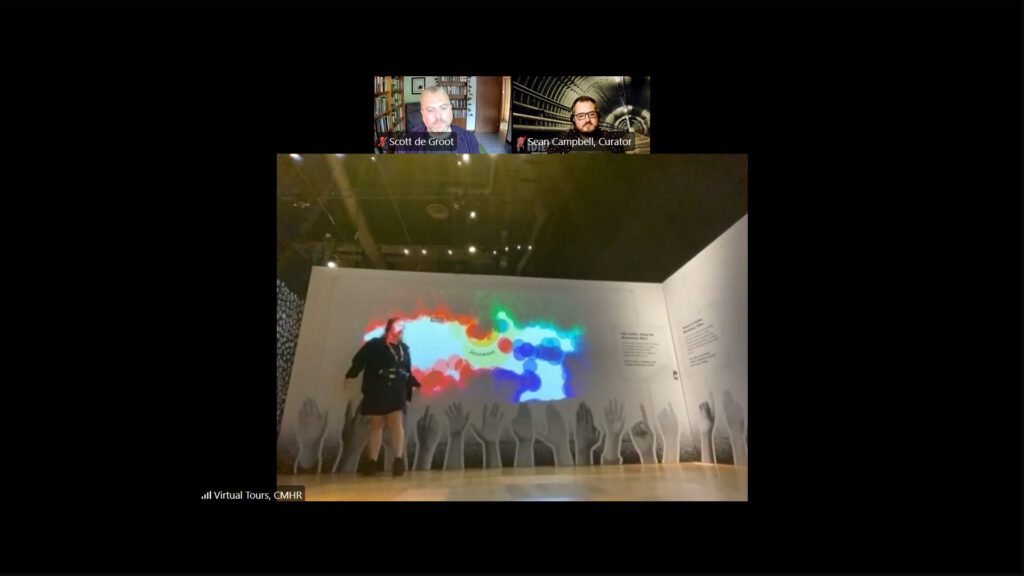
Emily Gartner, Program Interpreter at the Canadian Museum for Human Rights, began the evening by walking us through the museum’s exhibition, Love in a Dangerous Time: Canada’s LGBT Purge. Through the virtual tour, attendees could see the exhibition and follow the history of the LGBT Purge, from its roots in earlier laws and attitudes toward queerness through its development during the Cold War and its eventual end.
As Emily took us through the exhibition, she highlighted how this history connects to broader questions about human rights, including identity, security, and privacy. She asked the audience to consider questions such as: Does “normal” exist? Who is national security for? Are you being watched or recorded?
She began by placing the history of the Purge within a much longer history of queerness on the lands now known as Canada. Indigenous peoples and cultures are diverse, and there is a long history of queer Indigenous people across many cultures on Turtle Island. Colonization brought significant changes to these understandings, including the introduction of legal systems influenced by French and British law and Christian principles.
Queerness continued to exist despite laws that criminalized same-sex relationships and acts. During the First and Second World Wars, people in close quarters formed intimate relationships despite the threat of punishment.
After the Second World War, the Cold War brought a new focus on national security. The division between NATO and Warsaw Pact countries, the fear of Soviet espionage, and the Gouzenko Affair contributed to a growing culture of suspicion in Canada.
The government became concerned that queer people could be vulnerable to blackmail and therefore pose a security risk. This led to policies targeting queer people in the public service, military, and other areas of government.
The RCMP investigated and monitored people suspected of being queer. People were placed into categories including “alleged,” “suspected,” and “confirmed.” Investigators questioned people, as well as their friends and family, and monitored places where queer people gathered. People lost their jobs and were subjected to investigations, interrogation, and arrest.
In the 1950s and 1960s, the government also invested in new technologies. One example was an apparatus dubbed the “Fruit Machine,” which attempted to identify homosexuality through physiological responses to images and tests related to gender roles. It did not work, but it was used in interrogations and was humiliating and demeaning for the people subjected to it.
When the technology failed, surveillance continued. The RCMP monitored community spaces, including Ottawa’s Lord Elgin Hotel, and investigated people within its own ranks.
Emily also discussed the case of John Watkins, Canada’s ambassador to the USSR. Watkins was targeted by Soviet intelligence and faced blackmail because of his sexuality. He reported the approach to Canadian authorities rather than acting as a traitor. He was later interrogated by Canadian officials and died after suffering a heart attack while in Canadian custody.
During the 1960s and 1970s, gay rights activism grew. There was some change within the civil service, but investigations continued, particularly within the Canadian Armed Forces. Women in the military were also targeted, and investigators sometimes treated their interest in military service as evidence of homosexuality.
The LGBT Purge affected thousands of people over more than 40 years.
The Canadian Charter of Rights and Freedoms, including Section 15, helped create new opportunities to challenge discrimination. People began challenging the military and government in court. The RCMP ended its purge in 1988.
In 1992, Michelle Douglas, who had been investigated, interrogated, subjected to a polygraph examination, and discharged from the military, challenged the Canadian Armed Forces in Canada’s Supreme Court. Her case resulted in the formal end of the military’s policy.
In 2017, the Government of Canada apologized to those affected by the LGBT Purge. A class action lawsuit followed and was successful in 2018. The settlement established two funds: one for survivors and another to support education about the history of the Purge.
Building the Exhibition
Scott de Groot, Curator and Historian at the Canadian Museum for Human Rights, spoke about the development of Love in a Dangerous Time. Planning for the exhibition began in 2019.
The exhibition was developed as a community-oriented project and includes oral histories, artifacts from survivors, commissioned artwork, and an art film. It also includes an oral history kiosk where visitors can hear personal stories connected to the Purge.
Love in a Dangerous Time has received several awards, including the 2025 Governor General’s History Award for Excellence in Museums: History Alive! After nearly two years in Winnipeg, the exhibition will begin a national tour in 2027. Two pop-up versions of the exhibition are already travelling to non-museum venues across North America.
Rainbow Veterans of Canada Panel Discussion
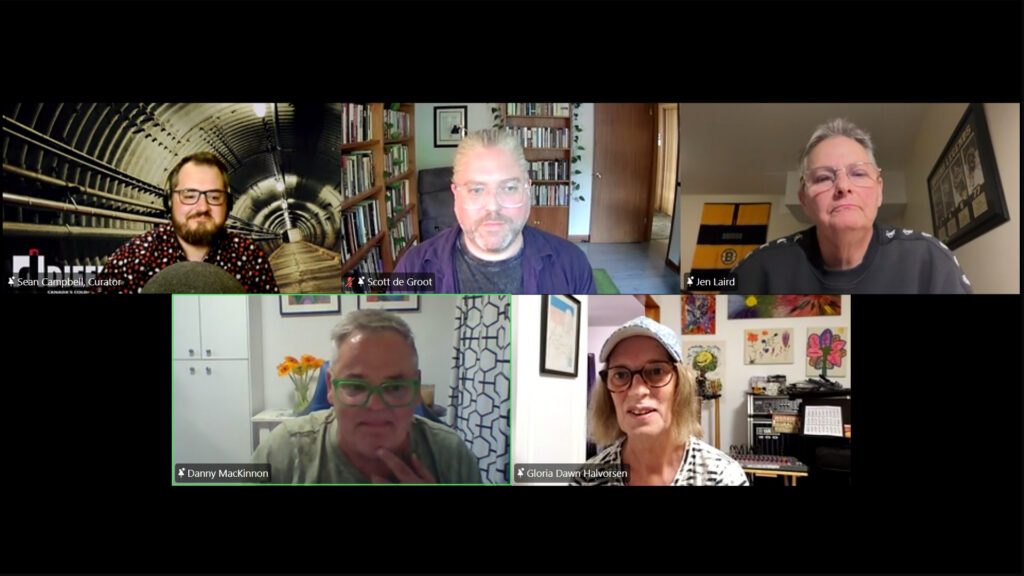
The second half of the event featured personal stories from three LGBT Purge Survivors and members of Rainbow Veterans of Canada.
Jen Laird grew up in a military family and joined the Canadian Armed Forces after high school. She wanted to become a Military Police officer and described loving her military training. At CFB Borden, she felt that she had found where she belonged.
Two weeks before graduating, Jen was taken out of class and interrogated. She was sent for a psychological assessment and was eventually diagnosed with “Homosexuality.” She was kept in limbo before receiving her release papers.
Jen was not out to her family and had to hide what had happened to her. She was later outed to her parents through an anonymous phone call. She described feeling that she had no future and eventually had very little contact with her family.
Jen later took part in the class action lawsuit. She spoke about carrying shame from what happened to her, while also wanting to make sure the same thing did not happen to anyone else.
Danny MacKinnon first enrolled in the military reserves in 1979 before joining the regular force as an Administration Clerk. He served in Canada and overseas, including with the Canadian Defence Liaison Staff in London, England.
While in London, Danny was called into his captain’s office and told, “They’re onto you.” He was told that the captain could no longer protect him and was forced into a voluntary discharge. Danny was not out as gay at the time.
He later returned to the Canadian Armed Forces in 2008. Learning about the class action lawsuit brought back difficult memories from his earlier experience. Danny spoke about experiencing PTSD and the impact that the Purge continued to have on his life.
Gloria Dawn Halvorsen came from a military family and joined the Royal Canadian Navy. She completed deployments and did well during her service.
During her third year, Gloria was investigated. Investigators questioned people in her hometown, and her contract was not renewed. At the time, she was male-presenting and had not transitioned. She was also not out.
Gloria later came out as transgender and became involved in human rights advocacy. She worked with elected representatives in New Brunswick and advocated for changes to rights, healthcare, and workers’ rights.
She also spoke about the challenges she has faced, including homelessness, cancer, underemployment, and violence. With support from a veterans advocate, she was able to access benefits. She has since reconnected with her grandchildren, received community recognition, and continues to make music and advocate for human rights.
The evening brought together the broader history of the LGBT Purge with the personal experiences of people who lived through it. Their stories show the lasting impact of a policy that affected thousands of people over more than four decades.
Thank you to Emily Gartner and Scott de Groot of the Canadian Museum for Human Rights, and to Jen Laird, Danny MacKinnon, and Gloria Dawn Halvorsen of Rainbow Veterans of Canada, for taking part in this important discussion and sharing their knowledge and experiences.
Learn More
To learn more about the history of the LGBT Purge, we encourage you to explore the work of Rainbow Veterans of Canada and the Canadian Museum for Human Rights’ Love in a Dangerous Time: Canada’s LGBT Purge exhibition.
We also recommend Canada’s War on Queers: National Security as Regulation by Gary Kinsman and Patrizia Gentile and the documentary The Fruit Machine by Sarah Fodey.
The event was presented in collaboration with the Mississippi Valley Textile Museum in Almonte, Ontario. The museum will also host an in-person event on the history of the Purge on Sunday, August 30 at 2:00 p.m.
Learn more about the other events in the 2026 Cold War Speaker Series!
September 24: Allied Intelligence Networks in the Early Cold War
October 15: Canadian Intelligence in the Early Cold War
November 19: Details to follow