
(19/25)
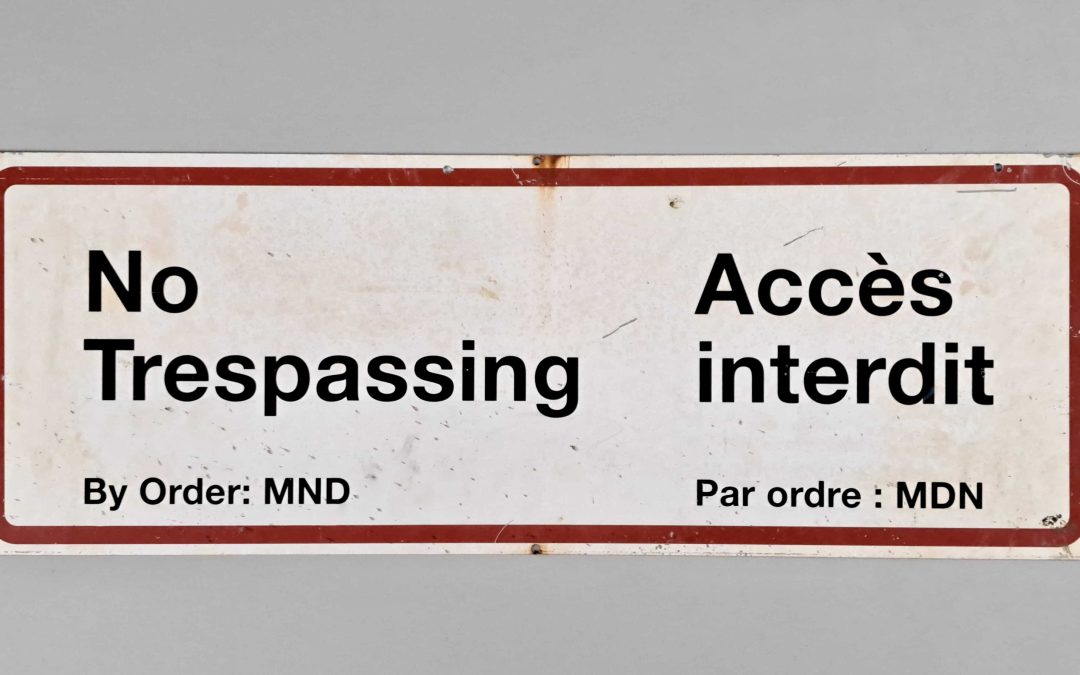
In honour of the Diefenbunker’s 25th anniversary, we continue to highlight 25 never-before-seen artifacts from within our collections. This week, we are featuring a “No Trespassing†sign from the Department of National Defence.

Secrecy was of the utmost importance for buildings in the Emergency Government Headquarters — the name given for a system of nuclear fallout shelters built by the Government of Canada in the 1950s and 60s. Personnel who worked in these sites were given specific clearances for different sections of the building, based on their role. Regional Emergency Government Headquarter (REGHQ) sites were part of the continuity of government planning to safeguard the workings of the government in the event of a nuclear attack on Canada during the height of the Cold War. These sites spanned from British Columbia to Nova Scotia and were found on military bases in: Nanaimo, BC; Penhold, AB; Shilo, MB, Barrie, ON; Valcartier, QC; and Debert, NS.
These REGHQ sites provided up to date information to the Central Emergency Government Headquarters (CEGHQ), or more commonly called the Diefenbunker. Located in Carp, ON, the Diefenbunker was the main site in the nationwide chain of bunkers. This sign in the Diefenbunker’s collections was acquired from the former REGHQ site located at Canadian Forces Base Borden in Barrie, Ontario. Like at the site in Borden, trespassing signs like this would be placed near specific areas of the Diefenbunker to deter personnel from entering restricted zones. In addition, a military police officer would have been stationed next to the signs to inform personnel that they were forbidden to enter that part of the building.

No Trespassing Sign, Diefenbunker Museum: 2000.016.003
This sign is approximately 35 inches long, constructed of galvanized steel — steel that has a protective zinc coating to prevent rusting — and is white with a red border. Within the border, the words “No Trespassing†are left-aligned in black text. The words “By Order: MND†are printed in smaller lettering directly below. On the righthand side is the French translations, printed in the same black text: “Accès interdit†in larger text and “Par ordre : MDN†in smaller text below. The production of this particular sign was ordered by the Minister of National Defence (MND), who would have been responsible for the management and direction of all matters relating to the national defence of Canada at the time.
The concept of trespassing was first introduced in the 14th century, however the origins of the “No Trespassing†sign can be traced back to 16th–century England, where landowners would post signs on their property to deter people from entering without permission. The first trespassing law was enacted in late 19th–century North America and, since then, “No Trespassing†signs have been used all around the world as a way for landowners to assert their property rights. Today, these signs continue to be used and original examples can still be found throughout the bunker!

Stay tuned as we continue to celebrate our 25th anniversary by uncovering stories from our museum’s collections.